When individuals see themselves reflected in collective journalistic narratives, they are more likely to participate in them.
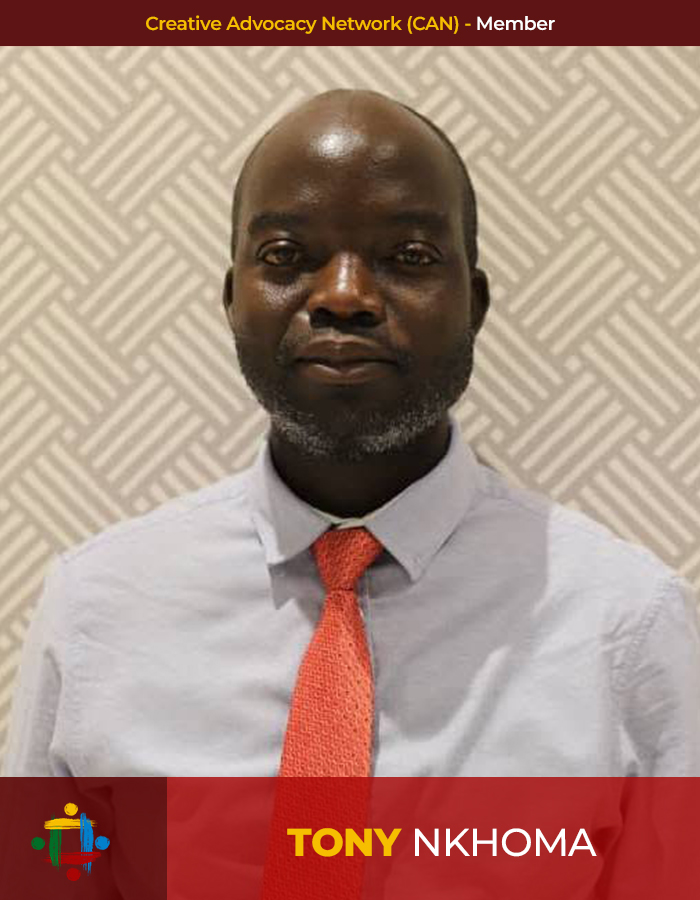
Professional and Trained Journalist
Mr Tony Nkhoma is a professional and trained journalist with over ten years of experience in the media industry. He is also a trained professional in marketing and project management. In the journey of his journalism, Tony Nkhoma has worked for the Zambia News and Information Services (ZANIS), Munati TV, and the Mast Newspapers. During this period he has also worked with various radio, TV, and online media organizations in collaboration.
“My journalistic stories have continued to make invisible issues visible, and personal experiences circulate widely, attracting policymakers’ attention and public conversation. This visibility has shifted public understanding of social and civic problems from abstract categories to urgent realities.
It is my strength in advocacy, human governance, and civil space journalistic expression, ordinary people in society have become part of my news-making process—and that shift for me is about to reshape how societies inform themselves, hold power to account, and drive collective change.
My commitment to promoting the principles of open journalism includes core values such as transparency, participatory engagement, accountability, mobilizing public opinion and collective action, and amplifying marginalized voices. What is citizen journalism?
I am convinced that when people are openly and genuinely engaged in a transparent civic space, public institutions become more responsive and innovative. Accountability is a central principle of the civic space. When everyone can contribute and critique, misinformation is more likely to be challenged and institutional blind spots more likely to be exposed.
Perhaps my most structurally significant contribution to my journalism is its capacity to give voice to communities that have historically been ignored or misrepresented. It changes the fundamental dynamic from communities being subjects of reporting to being their authors—a shift with real consequences for how issues of inequality, discrimination, and local injustice reach national or global attention.
Tailored to and with support from People’s Action for Accountability and Good Governance in Zambia PAAGS programs, I am convinced that narratives often shape which issues enter political and institutional agendas. Political leaders and lawmakers respond to community-driven storytelling campaigns, influencing debates on civil rights, gender equity, healthcare access, and environmental protection. Am convinced that when individuals see themselves reflected in collective journalistic narratives, they are more likely to participate in meetings, demonstrations, or policy advocacy. Shared stories generate solidarity, and solidarity generates coordinated action.
Social change requires institutions, resources, and political strategy—but it also requires narrative. When communities claim ownership of their stories, they claim ownership of their futures.
When Zambia’s Copyright Bill 2025, which proposed to repeal and replace the Copyright and Performance Rights Act (Cap 406 of the Laws of Zambia), came up, I took interest to read the contents. Using a journalist advocacy skill, I realize there were clauses, perhaps, which content owners did not understand, and I wondered, “How are they allowing the bill to be passed with such a clause to me, which seemingly was taking out the rightful and economic ownership of artistic creation?”
“The draft bill aims to update the terms of copyright protection and ensure a balanced outcome that supports access to knowledge, investment in content, and sustainable cultural development. Stakeholders are encouraged to participate in the consultation process and prepare for the operational changes the new law will bring.”
I contacted the Zambia Association of Musicians (ZAM) and the Zambia Copyright Protection Society (ZAMCOPS) to get their view on whether they will make a submission to comment on certain clauses and how they affect their general membership. This is one way I use journalism to bring about change in people’s lives, particularly those whose policies affect them.
Another project I jumped on, which raised a lot of concern, was when PAAGZ released its Status Report on the Evolution of the Legislative Landscape on Artistic Rights and Freedoms under the “New Dawn” Government in Zambia.
During this period, I gathered human rights and governance experts to discuss the artists’ rights and freedom under the New Dawn government with special focus to before, during, and after the August 13, 2026, general elections in Zambia. Particular focus was on the constitutional reforms and how they have impacted the civic space in the country. I gathered the aforementioned experts, and the stories were published in the Mast newspaper.
PAAGZ has, over the years, recognized my efforts in its CIVICUS: Digital Safety and Legal Awareness and Copyright and Creative Freedom accountability capacity-building initiatives. I rarely believed my efforts were just about making news stories; they were bridging the social impact gap and serving as a mechanism of social change in the civic space in the country.
Through this engagement and continued capacity building with various programs organized by the People’s Action for Accountability and Good Governance in Zambia, I have expanded my news source to real-life story storytelling that influences social change through several interconnected mechanisms.“